 azmater.com
 Fiber for Industry
Fiber is a type of carbohydrate that the human body cannot digest, playing a crucial role in digestive health. It is found in plant-based foods such as fruits, vegetables, whole grains, and legumes. Consuming adequate fiber helps regulate bowel movements, lowers cholesterol levels, and maintains stable blood sugar. Dietary fiber is divided into soluble and insoluble types, each offering unique benefits for gut health and disease prevention.
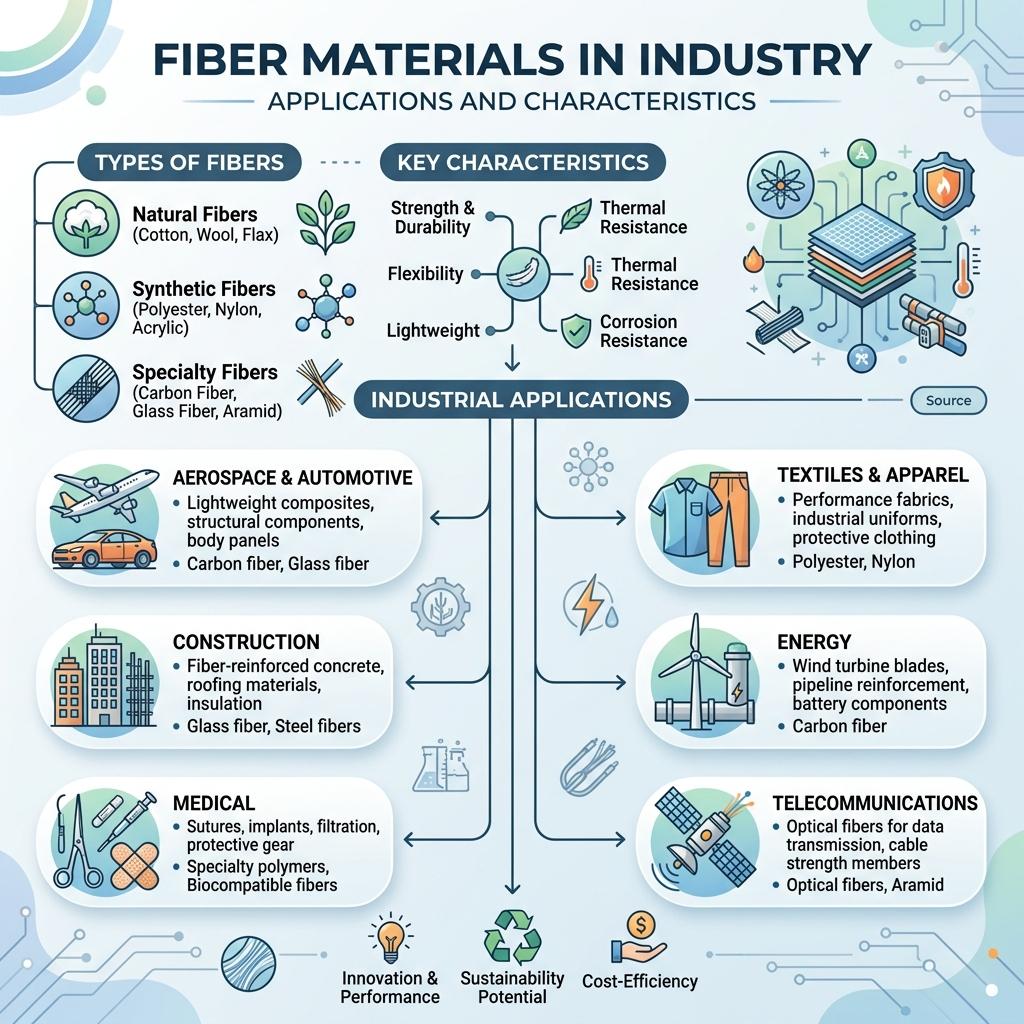
What are the main categories of fiber materials used in modern industry?
Industrial fibers are broadly categorized into two main groups based on their origin:
- Natural Fibers: Sourced from plants, animals, or minerals. Examples include cotton, jute, wool, and silk. In industry, they are increasingly valued for their biodegradability, low environmental impact, and use in sustainable biocomposites.
- Synthetic (Man-made) Fibers: Manufactured through chemical processes, usually derived from petrochemicals. Examples include polyester, nylon, carbon fiber, and glass fiber. They are engineered for specific industrial properties such as high tensile strength, extreme durability, and chemical resistance.
How does carbon fiber compare to traditional steel in industrial applications?
Carbon fiber is heavily favored in the aerospace, wind energy, and automotive industries because of its exceptional strength-to-weight ratio compared to steel. While steel remains cheaper and highly ductile, carbon fiber provides superior performance for lightweighting applications.
| Property | Carbon Fiber | Steel |
|---|---|---|
| Weight | Extremely lightweight | Heavy |
| Tensile Strength | Very high | High |
| Corrosion Resistance | Excellent (does not rust) | Vulnerable to oxidation/rust |
| Cost | High manufacturing cost | Relatively low cost |
What are the fundamental steps in manufacturing synthetic polymer fibers?
The production of synthetic fibers generally follows a process called "spinning," which involves four critical steps:
- Polymer Preparation: Solid polymers are either melted using high heat or dissolved in a chemical solvent to create a viscous liquid.
- Extrusion: This liquid is forcefully pumped through a "spinneret," a metal plate with microscopic holes, to form continuous strands.
- Solidification: The extruded strands are cooled (melt spinning), exposed to dry air (dry spinning), or submerged in a chemical bath (wet spinning) to harden into solid fibers.
- Drawing: The newly formed filaments are stretched. This aligns the polymer molecules along the fiber's axis, significantly increasing its structural strength.
What are the primary industrial applications of optical fibers?
Optical fibers, manufactured from ultra-pure glass or durable plastic, are designed to transmit light signals over vast distances. Their core industrial applications include:
- Telecommunications: They serve as the backbone of global internet and telephone networks due to their immense data bandwidth and minimal signal degradation.
- Medical Equipment: Widely used in endoscopy and laser surgeries, allowing for minimally invasive internal imaging and treatment.
- Industrial Sensors: Employed to monitor structural strain, temperature, and pressure in extreme environments, such as aerospace components or deep-sea oil rigs.
- Manufacturing: High-power fiber lasers are utilized for the precision cutting, welding, and marking of heavy metals.
Why is fiberglass (glass fiber) so extensively used in manufacturing and construction?
Fiberglass is one of the most widely used industrial fibers due to its outstanding balance of high performance and low manufacturing cost. It is typically woven into mats or used as reinforcement in plastics to create Fiber-Reinforced Polymers (FRP).
Key industrial advantages include:
- High Strength: It offers excellent tensile strength combined with lightweight properties, making it ideal for automotive parts and wind turbine blades.
- Insulation: It provides superb thermal and electrical insulation, making it the standard for building insulation and printed circuit boards.
- Corrosion Resistance: Unlike traditional metals, fiberglass does not rust or degrade rapidly, making it perfect for marine boat hulls, underground pipes, and chemical storage tanks.
What are the sustainability challenges associated with synthetic fibers?
While synthetic fibers like polyester and nylon dominate modern industry, they pose significant environmental challenges:
- Fossil Fuel Reliance: Their production is heavily dependent on petroleum extraction, contributing to high carbon footprints and greenhouse gas emissions.
- Microplastic Pollution: When washed or subjected to industrial friction, synthetic textiles shed microfibers. These microplastics bypass water treatment facilities and accumulate in oceans, severely harming marine ecosystems.
- Non-biodegradability: Synthetic fibers can take hundreds of years to decompose in landfills.
To combat this, industries are investing in chemical recycling technologies and developing bio-based synthetic polymers derived from plant sugars rather than crude oil.
How are natural industrial fibers classified based on their origin?
Natural fibers used in industry are classified into three main subcategories based on their biological or geological origin:
- Plant (Cellulosic) Fibers: Extracted from various plant parts.
- Seed fibers: Cotton, kapok.
- Bast (stem) fibers: Jute, flax, and hemp (widely used in packaging and modern bio-composites).
- Leaf fibers: Sisal, abaca (used for industrial ropes and cordage).
- Animal (Protein) Fibers: Derived from animal hair or secretions.
- Hair/Wool: Sheep's wool, alpaca.
- Secretions: Silk from silkworms.
- Mineral Fibers: Naturally occurring in rock formations.
- Asbestos: Historically heavily used for industrial fireproofing, but now largely banned globally due to severe health risks like mesothelioma.
What makes aramid fibers crucial for industrial safety gear?
Aramid fibers (aromatic polyamides), commercially known by brand names like Kevlar® and Nomex®, are a class of heat-resistant and remarkably strong synthetic fibers. They are indispensable in the industrial safety sector for two primary reasons:
- Ballistic and Cut Resistance: Aramid fibers feature a highly crystalline polymer structure, making them up to five times stronger than steel on an equal weight basis. This makes them the premier choice for bulletproof vests, industrial cut-resistant gloves, and forestry chaps.
- Thermal Stability: They possess excellent flame resistance. They do not ignite, melt, or rapidly degrade in normal oxygen levels, making them vital for firefighting turnout gear and high-voltage electrical insulation.
What is a Fiber-Reinforced Polymer (FRP) composite and how does it function?
A Fiber-Reinforced Polymer (FRP) is a highly engineered composite material consisting of two distinct components working in tandem to create a superior product:
- The Reinforcing Fibers: Materials like glass, carbon, or aramid fibers provide the primary load-carrying capacity, tensile strength, and stiffness to the composite.
- The Polymer Matrix: A plastic resin (such as epoxy, polyester, or vinyl ester) that encapsulates and binds the fibers together.
The matrix protects the delicate fibers from environmental damage, abrasion, and chemical attacks. Crucially, it transfers applied mechanical stress evenly across the fibers. FRPs are essential in aerospace engineering and civil infrastructure due to their customizable strength and extreme durability.
What is the difference between staple fibers and continuous filaments?
In the textile and industrial fiber sectors, fibers are categorized by their physical length, which directly dictates how they are processed and the properties of the final material.
| Characteristic | Staple Fibers | Continuous Filaments |
|---|---|---|
| Length | Short, discrete lengths (e.g., 1 to 8 inches). | Infinite or practically endless lengths. |
| Source | All natural fibers (except silk); synthetics cut to size. | Silk and all synthetic fibers as originally extruded. |
| Processing | Must be twisted together (spun) to form a usable yarn. | Can be used directly as yarn or bundled into cables. |
| Material Feel | Produces softer, fuzzier, and more breathable fabrics. | Produces smooth, dense, highly strong, and lustrous materials. |