 azmater.com
 Foam for Industry
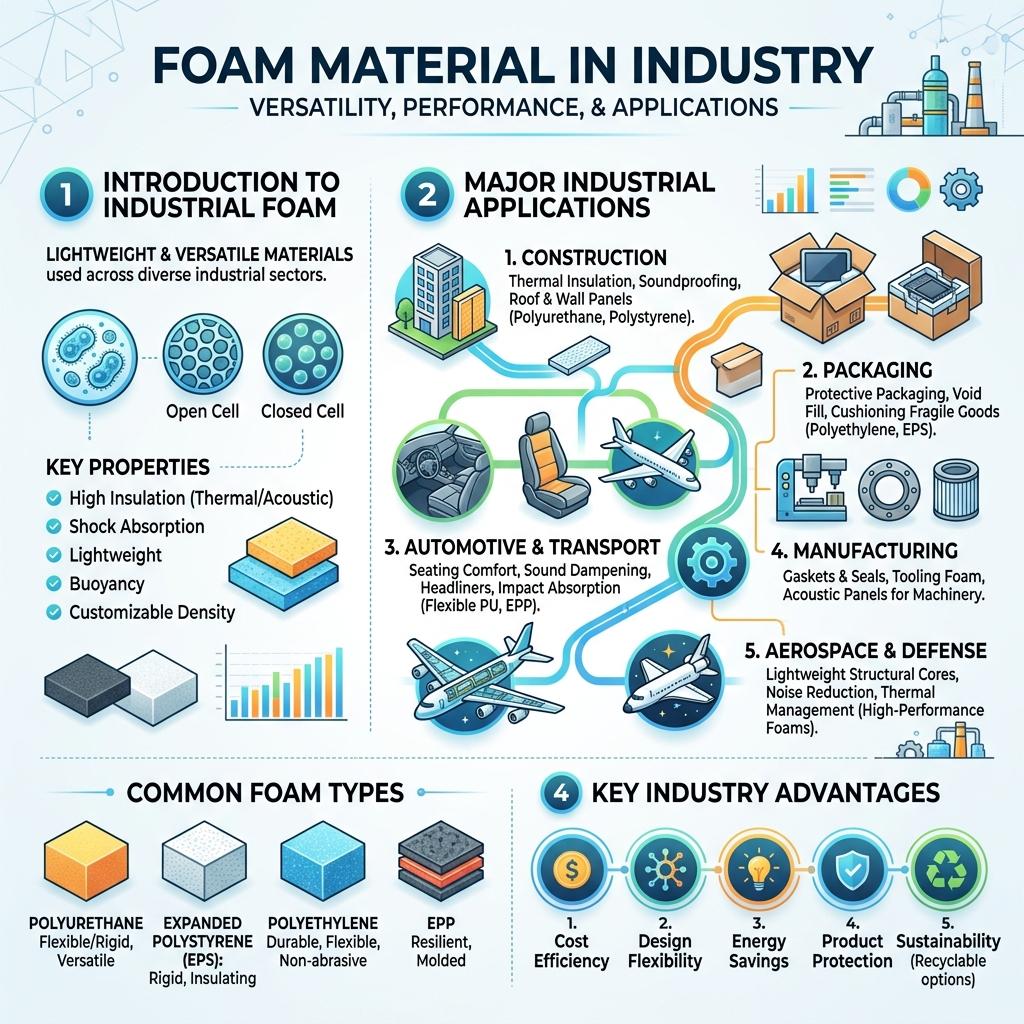
Foam is a lightweight material composed of gas bubbles trapped within a solid or liquid matrix, widely used for insulation, cushioning, and packaging. Its cellular structure provides excellent thermal resistance and shock absorption properties, making it essential in construction, automotive, and medical industries. The versatility of foam materials, including polyurethane, polystyrene, and polyethylene, supports diverse applications from furniture to soundproofing. Advanced foam technologies enhance durability, flexibility, and environmental sustainability through innovations like bio-based and recycled-content formulations.
What are the primary types of industrial foams based on their cellular structure?
Industrial foams are primarily classified into two structural categories, which dictate their physical properties and end-use applications:
| Foam Type | Cell Structure | Key Properties | Common Applications |
|---|---|---|---|
| Open-Cell | Interconnected pores | Soft, breathable, absorbent, flexible | Acoustic dampening, cushioning, filters |
| Closed-Cell | Isolated, sealed pores | Rigid, dense, water-resistant | Thermal insulation, marine buoyancy, weather stripping |
How is polyurethane (PU) foam manufactured for industrial use?
Polyurethane foam is created through a controlled exothermic chemical reaction. The basic manufacturing process involves the following steps:
- Preparation: Two primary liquid chemicals—polyols and diisocyanates—are precisely measured and heated.
- Mixing and Blowing: The liquids are mixed with a blowing agent (and often catalysts and surfactants). The chemical reaction releases gas, causing the mixture to expand rapidly into a foam.
- Curing: The expanding foam is poured onto a conveyor (slabstock) or injected into a mold. It is then left to cure and harden at room temperature.
- Fabrication: Once fully cured, large foam blocks are sliced, die-cut, or profiled into their final industrial shapes.
What are the main industrial applications of expanded polystyrene (EPS) foam?
Expanded Polystyrene (EPS) is a lightweight, closed-cell rigid foam highly valued for its shock absorption and low thermal conductivity. Its primary industrial applications include:
- Construction and Architecture
- Thermal insulation boards for walls and roofs.
- Geofoam blocks for lightweight road stabilization.
- Industrial Packaging
- Custom-molded shock-absorbing inserts for electronics.
- Temperature-controlled packaging for pharmaceuticals.
- Marine Infrastructure
- Buoyancy billets for floating docks and pontoons.
Why is syntactic foam used in the marine and aerospace industries?
Syntactic foam is a specialized composite material engineered by embedding microscopic hollow spheres (made of glass, ceramic, or polymer) into a resin matrix, such as epoxy. This unique structure provides critical benefits for demanding environments:
- High Strength-to-Weight Ratio: It offers immense compressive strength while remaining extremely lightweight, making it ideal for aerospace structural components.
- Deep-Water Buoyancy: It resists hydrostatic pressure at extreme ocean depths, preventing the foam from crushing. This makes it the standard material for Deep Submergence Vehicles (DSVs) and remotely operated underwater vehicles (ROVs).
- Low Moisture Absorption: The closed-cell nature of the embedded spheres prevents water logging over long periods.
What is the difference between physical and chemical blowing agents in foam production?
Blowing agents are responsible for creating the cellular matrix within foam materials. They operate via two distinct mechanisms:
| Agent Type | Mechanism of Action | Examples |
|---|---|---|
| Physical | Undergoes a phase change (typically boiling from liquid to gas) due to the heat of the reaction, expanding the polymer without altering its chemical makeup. | Pentane, liquid carbon dioxide, fluorocarbons. |
| Chemical | Undergoes a chemical reaction or thermal decomposition, creating a gas (like nitrogen or CO2) as a byproduct to inflate the foam. | Water (reacts with isocyanate in PU foam), Azodicarbonamide. |
How do industrial metal foams differ from traditional polymer foams?
While both feature a porous, cellular structure, metal foams (typically made from aluminum, titanium, or copper) retain the physical characteristics of metals, giving them a distinct advantage over polymer foams in extreme conditions.
Unlike standard polymer foams, metal foams are entirely non-flammable and do not emit toxic fumes when exposed to fire. They can withstand incredibly high temperatures, making them suitable for aerospace heat shields. Furthermore, metal foams offer excellent electrical and thermal conductivity, as well as superior impact energy absorption, which is highly utilized in automotive crash zones and blast-mitigation panels.
What safety and environmental concerns are associated with industrial foam production?
Industrial foam production presents several environmental and occupational health challenges that must be strictly managed:
- Toxic Chemical Exposure:
- Isocyanates used in PU foam can cause severe respiratory issues and occupational asthma if inhaled.
- Environmental Impact of Blowing Agents:
- Historically, CFCs and HCFCs depleted the ozone layer. While phased out, some modern HFC replacements still possess high Global Warming Potential (GWP).
- Flammability:
- Many polymer foams are highly flammable and require the addition of chemical flame retardants, some of which are persistent organic pollutants.
- Waste and Recycling:
- Thermoset foams are difficult to melt and recycle, contributing to landfill waste.
What characteristics of silicone foam make it ideal for the electronics industry?
Silicone foam is a premium, high-performance synthetic elastomer. It is heavily utilized in the manufacturing and protection of electronic components due to its specific physical and chemical properties:
- Thermal Stability: It remains flexible and does not degrade in extreme temperatures ranging from -55°C to over 200°C.
- Environmental Sealing: It possesses an excellent, low compression set, allowing it to form watertight and airtight seals against dust and moisture (IP-rated enclosures).
- Flame Retardancy: Many silicone foams naturally meet strict UL94 V-0 flammability standards.
- Dielectric Properties: It acts as an excellent electrical insulator, preventing short circuits within dense electronic assemblies.
How is cross-linked polyethylene (XLPE) foam different from standard PE foam?
Standard polyethylene (PE) foam consists of independent, unlinked polymer chains, which makes it a good, basic cushioning material. However, it is susceptible to tearing and thermal degradation.
Cross-linked polyethylene (XLPE) foam undergoes a specialized chemical or irradiation process that connects these individual polymer chains into a durable, three-dimensional network. This structural alteration gives XLPE significant industrial advantages: a much smoother surface, higher tensile strength, superior tear resistance, better thermal stability, and enhanced resistance to harsh chemicals. XLPE is routinely used in medical packaging, automotive gaskets, and high-end thermal insulation.
What are the standard test methods used to evaluate industrial foam properties?
To ensure industrial foams meet rigorous performance standards, engineers subject them to standardized tests (often defined by ASTM or ISO):
- Density Testing: Measures the mass per unit volume, which dictates the foam's weight, durability, and cost.
- Indentation Force Deflection (IFD):
- Measures the firmness and load-bearing capacity of flexible foams by recording the force required to compress the foam by a specific percentage (e.g., 25% or 65%).
- Compression Set: Evaluates the foam's ability to return to its original thickness after prolonged compression.
- Tensile and Tear Strength: Determines the force required to break or tear the foam material.